

God's Heart Behind the Tithe – Part 1
Tithing in the World of Israel
Within Israel, tithes were not an arbitrary financial rule, but a loving ordinance established by God: for His service, for those who had been set apart for that service, and for people who might otherwise have been forgotten.
Church,
Much has been said and taught about tithing. The conversation often begins immediately with a percentage: ten percent.
Is it required? Should it be calculated from gross income or net income? To whom should it be given? And what happens if I do not give it?
But perhaps we are starting in the wrong place.
Whenever God gives a command, the question is not only:
"What must I do?"
But above all:
"Lord, why did You give this command? What is the purpose of this law? What do You want to protect through it?"
God never simply says,
"Do this because I say so."
Behind every law there is a reason.
A purpose.
Something that God wants to protect.
God's commandments are never arbitrary rules. They reveal His character.
He forbids murder because He values life.
He forbids lying because He protects truth and trust.
He gave the Sabbath because people were not created to work continually without rest.
Behind God's commandments stand His wisdom, His righteousness, and His love.
The same is true of tithing.
If we see tithing only as a percentage that God demands, we may completely miss God's heart.
That is why today we are going back to the world in which God gave this law.
Tithing Belonged to Israel's Society
Israel was not a modern society.
There was no state pension.
No retirement fund.
No unemployment benefits.
No child allowance.
No insurance.
Most people lived from their land, their flocks, and the produce of their labor.
That is why the Law speaks about tithes of:
- grain
- wine
- oil
- livestock
These were the products of the land that God had given to Israel.
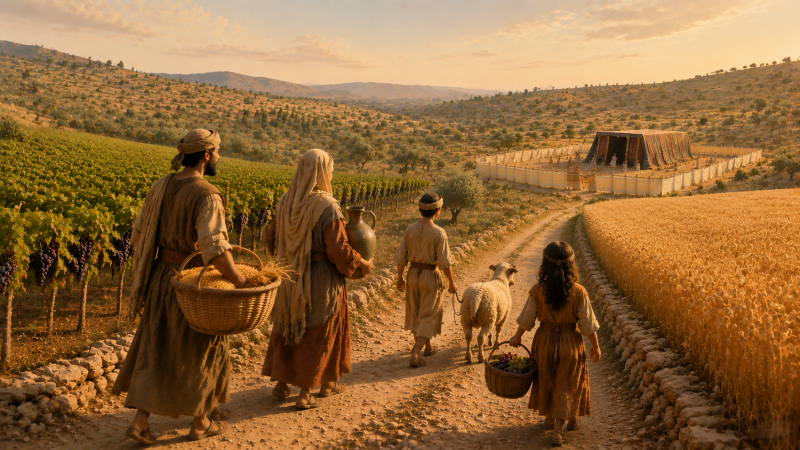
Tithes were therefore connected with:
- the land
- the twelve tribes
- the Levites
- the tabernacle, and later the temple
They were not an isolated financial principle that could simply be removed from that context.
They were part of an order established by God.
That does not mean we cannot learn from it.
Quite the opposite.
But we must not separate this order from its original context and simply apply it directly to the church.
And when we take a closer look at this order, we discover something beautiful:
God's mercy.
The Levites: Set Apart for God's Service
The tribes of Israel received land as their inheritance.
But the Levites did not.
God said:
"I am your inheritance."
They were given cities in which to live, along with pastureland.
But they did not receive farmland like the other tribes.
Why not?
Because God set them apart for service:
- in the tabernacle
- and later in the temple
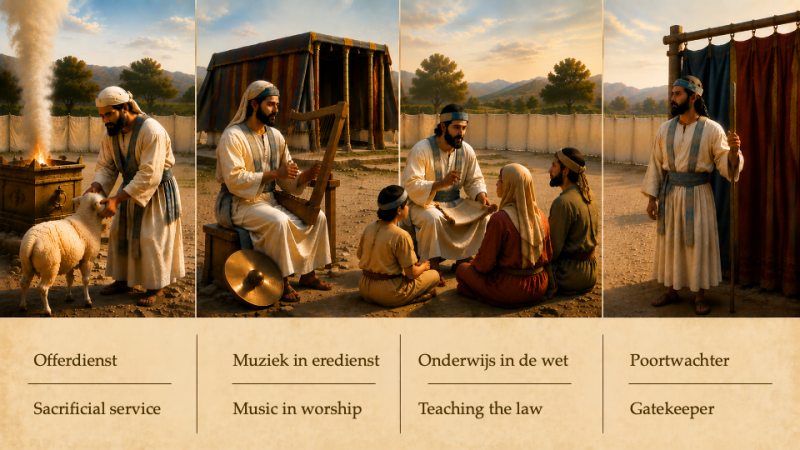
The priests offered the sacrifices.
The Levites assisted by providing:
- security
- practical support
- teaching
- music
- and caring for everything related to the worship of God.
Serving God was an intensive responsibility.
It was not something you could simply do alongside running a full-time farming business.
And possessions require attention.
We know that from our own experience:
maintenance...
repairs...
time...
energy.
For an Israelite farmer, this was even more true.
That is why God entrusted the Levites with a different responsibility,
and provided for them through the other tribes.
Numbers 18 says:
The tithes were their inheritance.
This was not a payment to an organization,
but God's provision for people whom He had set apart for His service.
Tithes and Rejoicing Before the Lord
In Deuteronomy we discover another beautiful truth.
Tithes were not merely a contribution.
Israel was to eat before the Lord and rejoice:
- with their family
- and with the Levites.
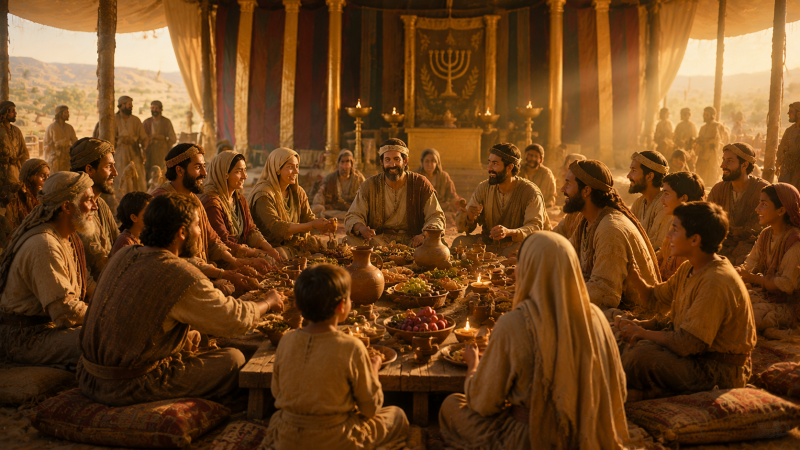
God connected giving with:
- worship
- gratitude
- fellowship
This was not a cold financial system.
Tithes reminded Israel that:
- the land belongs to God
- the harvest comes from God
- we live by His blessing
God did not want a people who only produced and consumed,
but a people who shared
and lived with grateful hearts.
God's Care for the Vulnerable
In Deuteronomy 14 and 26, it becomes even clearer.
Every third year there was a special provision for:
- the Levites
- the foreigners
- the orphans
- the widows
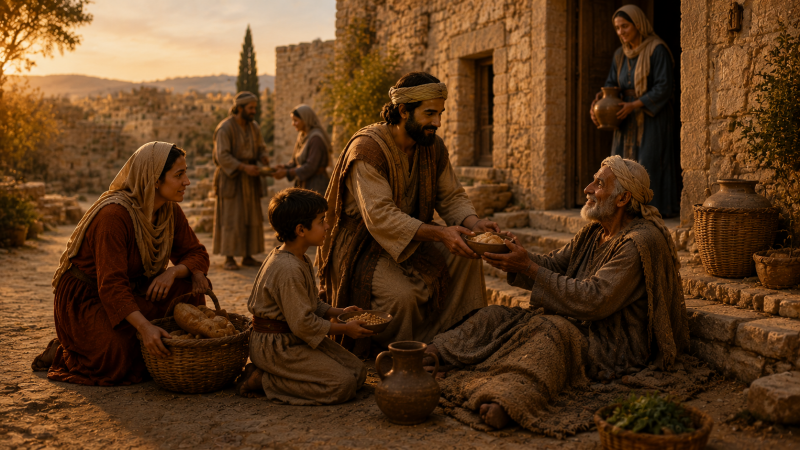
Why these people?
Because they were vulnerable.
- They had no land.
- They had no support network.
- They had no security.
God saw them.
He did not leave their care to chance.
He built mercy into the very structure of His people.
No one was to be forgotten.
👉 In Israel, tithing was not primarily about money—it was about people.
God Does Not Need Money
Psalm 50 says:
"The earth is the LORD's."
God does not need our resources because He is poor.
But people do need one another.
God teaches His people:
- to trust
- to share
- to care for one another
He breaks the power of greed
and teaches us that our possessions are also meant to be used to do good.
From Family to Nation
Abraham, Isaac, and Jacob lived as families and as foreigners in the land. They had not yet received the extensive body of laws that Israel would later receive at Mount Sinai. They lived as nomadic shepherds, depending on their families and living from their flocks and possessions.
But that does not mean there were no laws or regulations at all. They traveled through different regions and lived among established societies, each with its own rulers, laws, customs, and responsibilities. Even as a foreigner, you were expected to live according to the laws of the land.
So the difference is not that there was no law before Moses.
The difference is that Israel later received its own covenant law from God as a nation.
When God brought the Israelites out of Egypt, everything changed.
They were no longer just a family.
What had begun with Abraham as a family
had now grown into a great nation.
God brought this nation into its own land—
Canaan.

And a great nation living together in its own land needs its own order.
That is why God gave His Law:
rules for living with God
and for living with one another.
It was within that covenant order
that the tithe found its place.
Abraham: A One-Time Event
Abraham gave a tenth to Melchizedek.
But the question is:
A tenth of what?
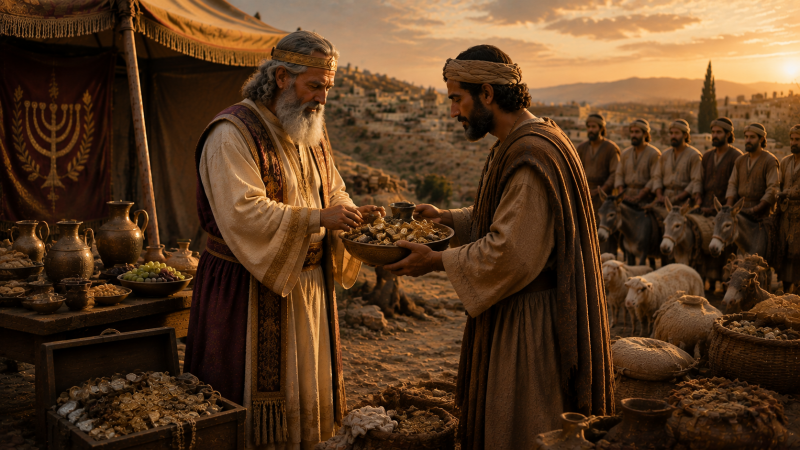
Genesis 14 shows that it was a tenth of the spoils of war.
And the New Testament confirms this.
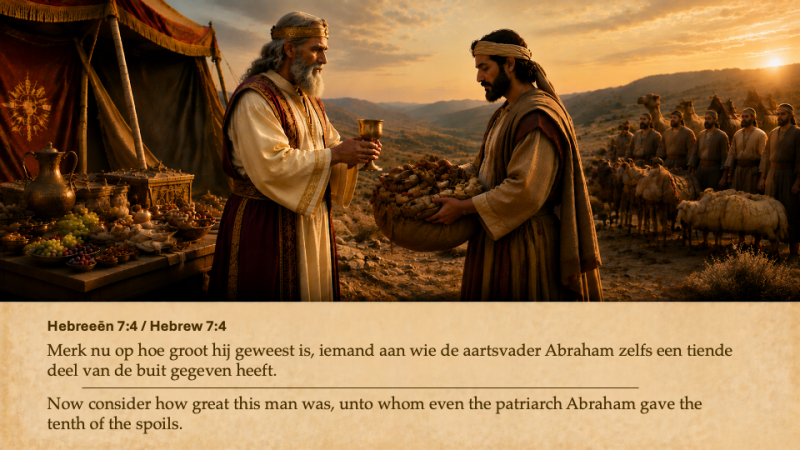
So it was not a regular tenth of Abraham's income or possessions,
but a unique, one-time event.
Nowhere does the Bible say that this became a continuing practice.
Only later did God establish a legal system of tithing within Israel.
Therefore, this account is not the foundation for a recurring Christian obligation to tithe.
Jacob: A Personal Vow
Jacob said:
"If You bless me... then I will give You a tenth."

Dat is:
- geen gebod van God
- maar een persoonlijke, voorwaardelijke gelofte
De Bijbel zegt niet hoe hij dit uitvoerde. Aan wie gaf hij de tienden? Tempel bestond toen nog niet.
Ook hier:
geen algemene regel, maar een individueel moment.
Malachi: "You Are Robbing Me"
Malachi 3 is often used to create fear.
But let us read the passage carefully.
It speaks about:
- tithes
- the temple
- the storehouse
- Israel's covenant system of care
God also speaks about:
- laborers
- widows
- orphans
- foreigners
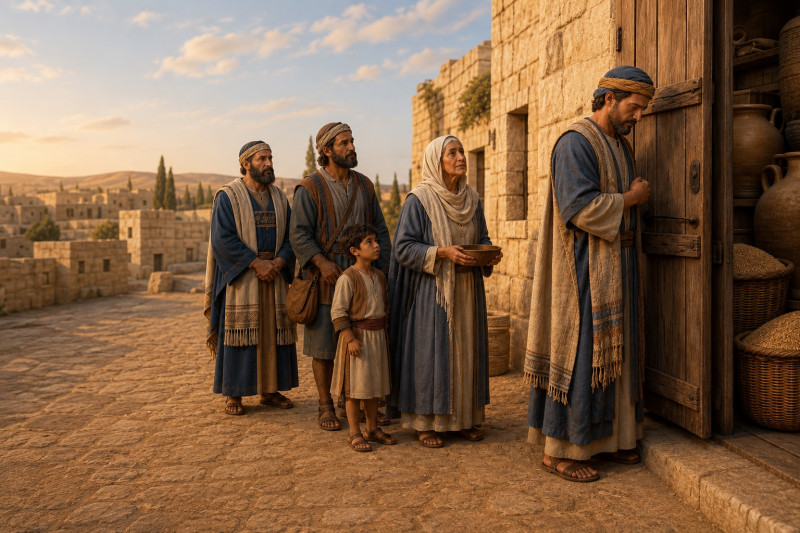
When Israel withheld the tithes:
- there was less for the temple,
- and less for the people God intended to care for.
God's merciful order was being undermined.
That is why God says:
"You are robbing Me."
Not because He needed anything,
but because His people were neglecting His care for others.
Legalism Misses God's Heart
Legalism asks:
"Have I paid the required percentage?"
But Jesus looks at:
- justice
- mercy
- faithfulness
You can give exactly the right amount
and still miss the heart of God.
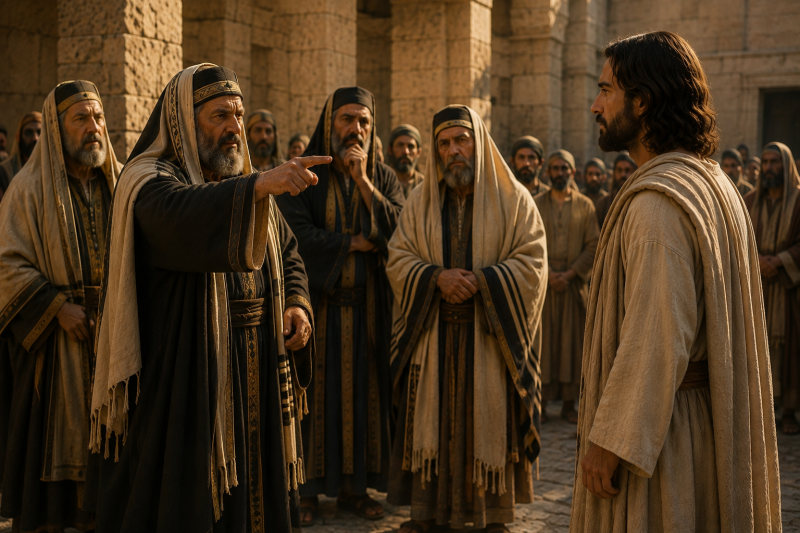
God is not looking for people who merely follow rules,
but for people who reflect His character.
When you become legalistic, you can be so occupied with rules
that you completely miss God's heart.
But when you begin to see how deeply God loves people,
your own heart changes—
and your life changes with it.
Conclusion
Today we have laid the foundation.
Tithing was:
- not an arbitrary rule,
- but part of God's loving care.
For:
- His service,
- the Levites,
- the vulnerable.
Therefore, the real question is not:
"What percentage should I give?"
But rather:
"Lord, what do You want to protect?
Whom do You want me to see?
How can Your mercy become visible through my life?"
Because God has not changed.
He is still:
- the God who sees,
- the God who cares,
- the God who does not want anyone to be forgotten.
Amen.